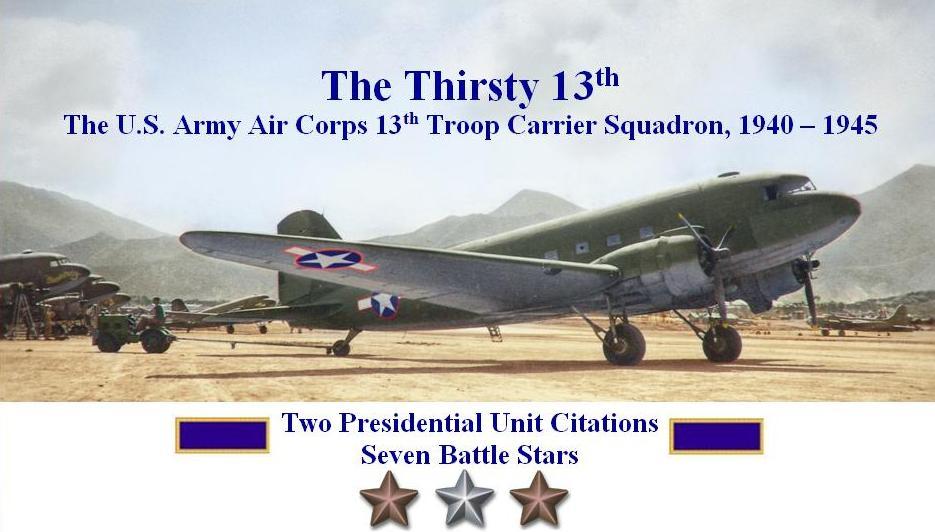
Many people when they think of military airplanes think of only fighters and bombers, but there is a third type: the cargo plane. The C-47 was so important that General, and future President, Eisenhower wrote in "Crusade in Europe:" "Four pieces of equipment that most senior officers came to regard as among the most vital to our success were the bulldozer, jeep, 2 1/2 ton truck, and the C-47," and this was the only aircraft he mentioned.
Flying cargo planes was more dangerous than being in a fighter or bomber, because the C-47 was a large target, slow (150 MPH), a valuable target (it carried airplane fuel, torpedos, guns, supplies, and important people and messages), had no protective armor (no thick steel plates in the walls by the pilots), and it was unarmed. How many people would like to fly one of these into a battle area? Very few.
C-47 pilots also faced another and often more deadly force than enemy aircraft: the weather. Fighters and bombers usually flew only in good weather, and had oxygen to climb above low storms. C-47s took off regardless of the weather - the peresonnel, supplies, and mail had to go through. Because it did not provide oxygen for the passengers, they also had to stay below 12,500 feet. Many aircrews lost their lives due to encounters with bad weather and mountains. Flying cargo planes in the South Pacific, an area known for intense storms, long distances over water, and mountainous islands, may therefore have been one of the most treacherous flying positions in World War II.
This website is dedicated to preserving the memory of one of the first military transport squadrons, and arguably the best ever, the U.S. Army Air Corps 13th Troop Carrier Squadron, also known as the Thirsty 13th. Their history was written in a highly-detailed 800-page book, and continues to be written in newsleters, with links to these below.
In 2010 I purchased one of the first 13 aircraft they flew to the South Pacific in 1942 to be restored, to bring people literally in touch with the squadron 75 years later, but that did not go as planned.
The October 6, 1942, order sending 172 ground crew members from Ohio to the San Francisco Port of Embarkation may be downloaded by clicking here. A PDF of a roster of all of the enlisted men ever in the squadron overseas through May 15, 1945, may be viewed and downloaded by clicking here. A roster of all of the officers and enlisted men still in the squadron September 22, 1945, may be viewed and downloaded here.

The Thirsty 13th was one of the first U.S. Army transport squadrons, and the very first in the South Pacific, an area unique for its combination of long distances over water, mountains, and challenging weather.
The 13th Troop Carrier Squadron arrived in New Caledonia at a critical time in World War II’s battle for Guadalcanal, the turning point in the Pacific War. It delivered to the Marines supplies that were key to holding the island. It went on to support six more battles, in the Northern Solomons, the Bismarck Archipelago, the Western Pacific, New Guinea, Luzon, and the Southern Philippines. It was also one of the eventually five transport squadrons for the Thirteenth “Jungle” Air Force, flying critical supply and evacuation missions into forward areas, and moving fighter, bomber, and other units to forward bases.
The squadron’s accomplishments were recognized by twice being awarded the highest honor a military unit may receive: the Presidential Unit Citation (Army). It also received many commendations.
The Thirsty 13th may be the #1 transport squadron ever, based on its safety record. In three years of flying 9.7 million miles, almost entirely over water, through often terrible weather, the squadron lost only one load (of 17 passengers) entrusted to it.
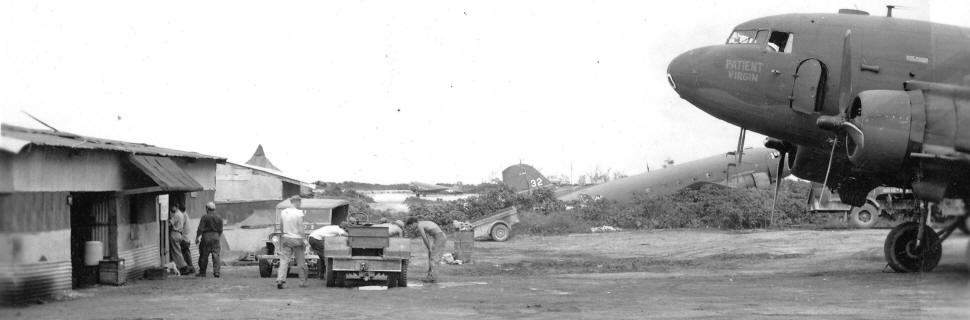
The squadron had four main overseas camps, marked above right with green pins, being (from right to left): Tontouta, New Caledonia; Espiritu Santo, New Hebrides; Biak, New Guinea; and Dulag, on Leyte in the Philppines. The air echelon was based at these and also four additional camps, marked with yellow pins: Plaine des Gaiacs, New Caledonia; Los Negros in the Admiralty Islands; and Wakde and Noemfoor, New Guinea. Pictured above is “the line” at Tontouta Air Base in New Caledonia in early 1943. Pictured below are the squadron work buildings and two of its C-47s at Mokmer Aerodrome on Biak Island in early 1944.
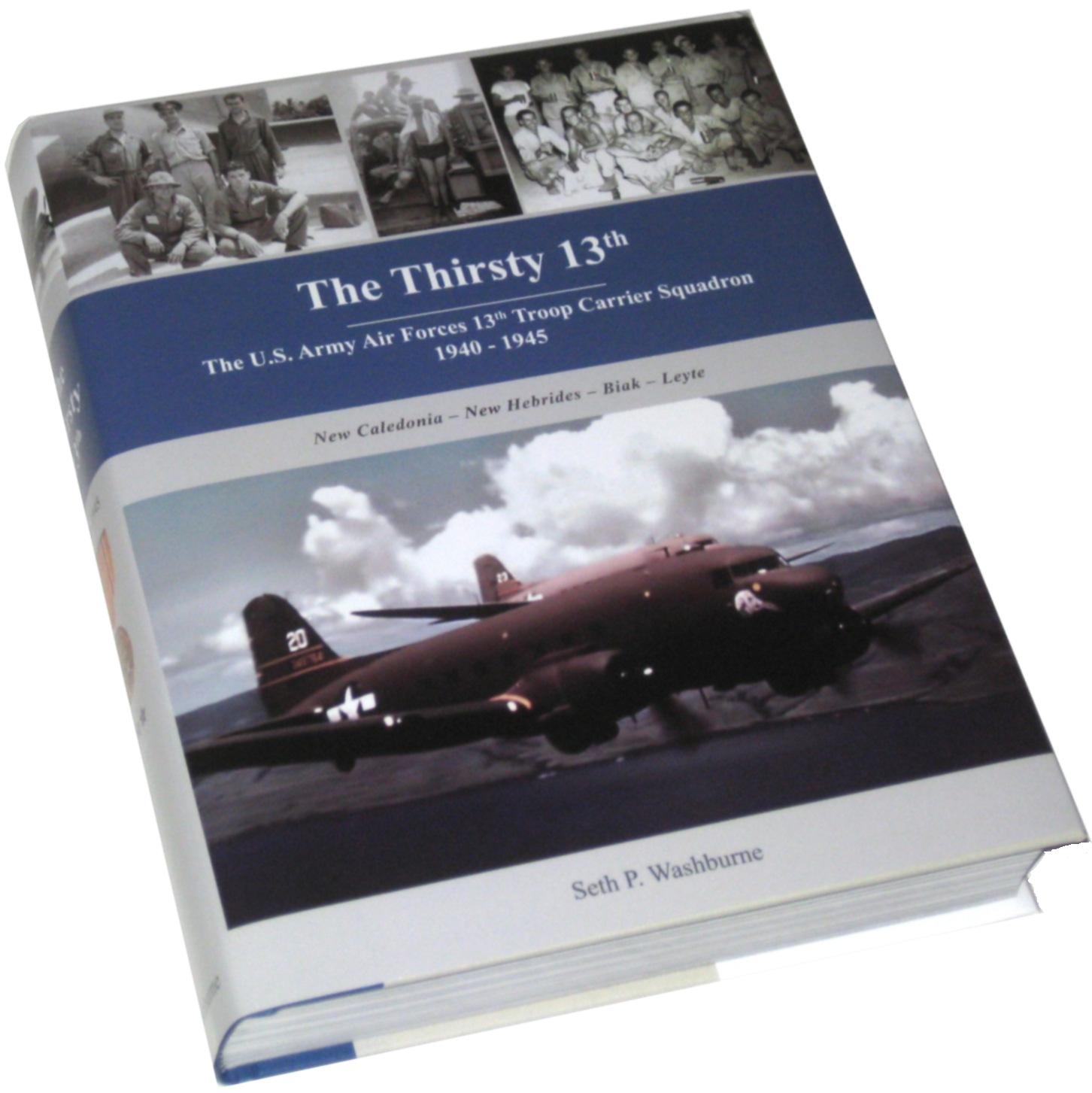
The Thirsty 13th is a limited-edition history of the squadron, released November 17, 2011. It includes:
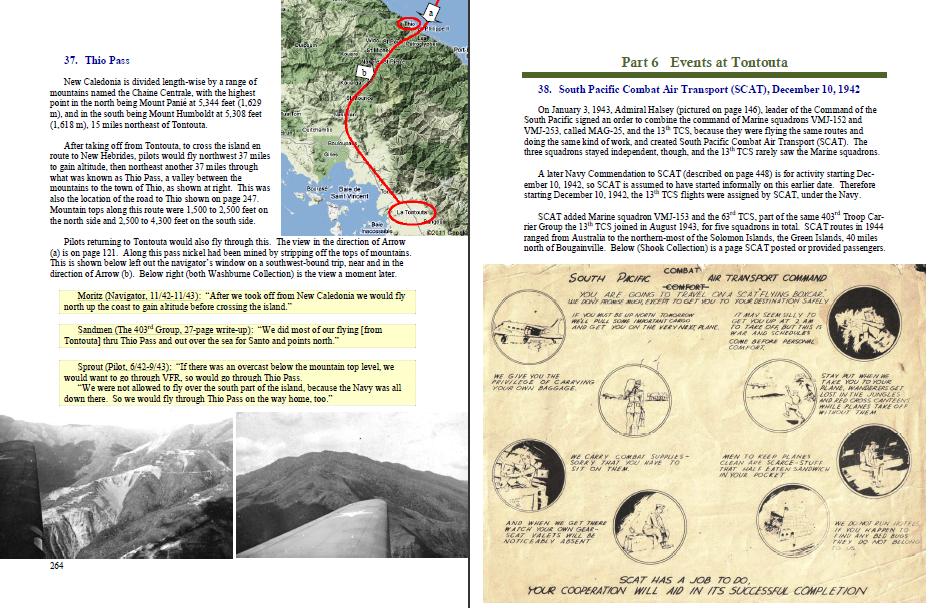
This book will be of interest to:
Flying Procedures and Organizations - South Pacific Airfields Then and Now - What They Did for Fun
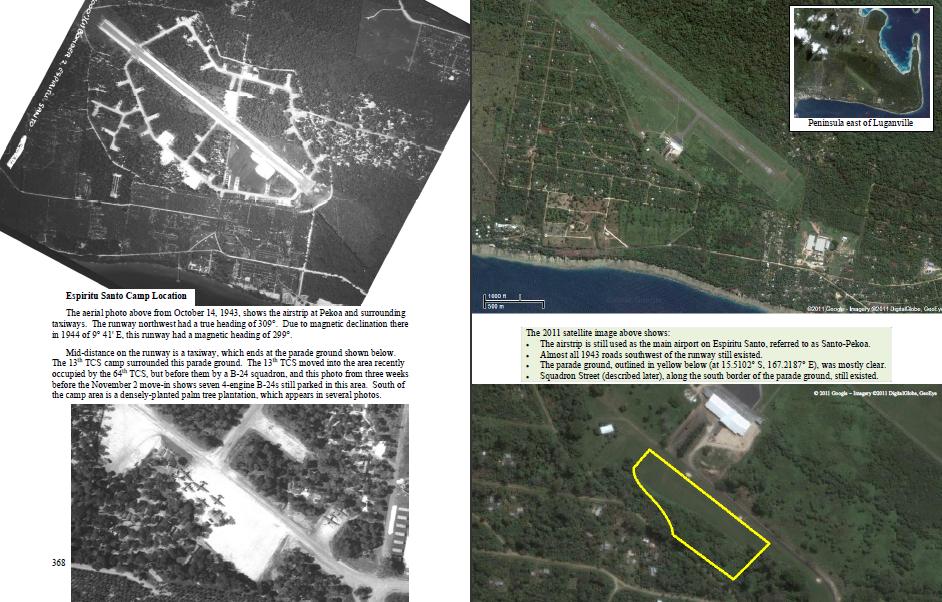
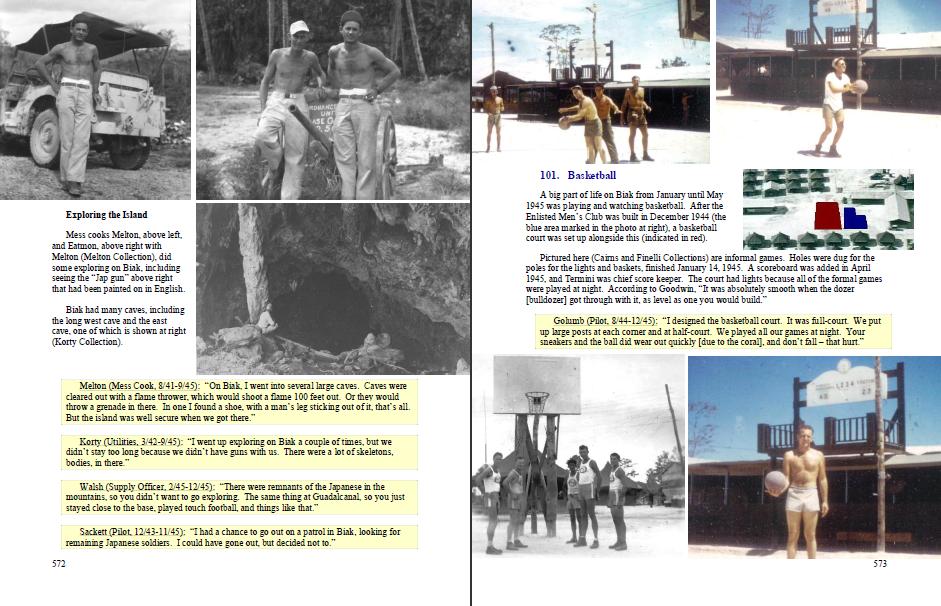
From 2015 to 2018, I mailed free books, and paid the postage, to relatives of members, and ran out of books in August 2018. Third-party sellers offer them online and are not in touch with me. I plan to create a second edition around 2027.
The First Edition of "The Thirsty 13th" is available on Amazon, and other websites. The original 2,300 shrink-wrapped books have been distributed, but the ones online are often in near-mint condition. I may get some new books back from an overseas museum to which I donated 96 books, if some are unsold, and so please contact me if interested in one of those.
I hope to create a Second Edition. This will be a set of free PDFs, which will be easier to share with family members, and future generations, and will be searchable on the Internet. If enough people want a hardcopy of the Second Edition, I could print some hard copies of that edition as well. I estimate this won't be available until the end of 2020 at the earliest.
In the meantime I can email you PDFs of pages from the book showing the exact locations of the camps where your relative served, and other relevant pages. I also have hundreds of military orders, and about 5,000 photos, and can email you items that include your relative.
I have made an enormous effort to find relatives of squadron members, and so if you, too, are related to a member of this squadron, please contact me at (212) 289-1506 or email me at sethpw1@gmail.com.
Several movie clips were found relevant to the Thirsty 13th. They were uploaded to YouTube and may be seen in an separate window by clicking on any of the following links.
Guadalcanal transports beached west of Henderson Field in Oct-Nov 1942 - seen by Thirsty 13th flight crews, this by the 13th AF in July 1943.
Russell Islands' Renard Airdrome and Thirsty 13th C-47 Sweet Leilani - This C-47 joined the squadron in May 1943, and is shown on the first island west of Guadalcanal, to where the squadron flew in June 1943.
Tontouta Flight Line, Takeoff, Landing at Munda - the squadron line in 1943, a takeoff from New Caledonia by a Marine crew, and loading wounded at Munda.
Rendova Island - the Northern Solomons in color.
Transporting the movie - featuring the Thirsty 13th unloading movie reels brought to Bougainville in late 1943 or early 1944.
Ending minutes of the Bob Hope Show - this show was seen by Thirsty 13th members August 2-3, 1944, in New Hebrides.
C-47s landing at and departing from Biak, estimated at Borokoe aerodome.
Wakde and Biak Camps, Formation Flight - color movie footage from 1944-45 by squadron pilot Graham Rice.
Typical Air Crew, Peleliu, and Biak Aerial - An unrelated air crew, but representative of the inside of a C-47. Then airfields Peleliu and Biak to where the squadron flew.
Drop Missions - The Thirsty 13th first made these in November 1942 to Marines on Guadalcanal, and then to units in the Northern Solomons, New Guinea, and in the Philippines. This is a short movie of a similar run, in 1942 by the Air Transport Command.
Drop Missions with Parachutes - includes footage over Bougainville in the Solomons potentially by the Thirsty 13th.
Two Down and One to Go - a 1945 movie seen by squadron members at Biak, about the Axis threat to the United States and the US response.
Thirsty 13th 70th Anniversary Reunion - Left-seat flying in Texas on November 4, 2011 by six 1943-1945 pilots.
13th TCS C-47 Lady Eve on Henderson Field, Dec 1942 - Thirsty 13th loading at Henderson Field, on Guadalcanal, shown in the first 2 minutes only. We are not in the rest of the movie.
Landing at Espiritu Santo, Pekoa, July 28, 2022 - Landing at Espiritu Santo to the NW, with a view toward Palikulo Bay, by Ewan Stevenson of New Zealand-based MIA search company Sealark Exploration Inc..
13th TCS Parade Ground July 25, 2022 - 13th TCS WWIi 1943-1944 camp location on July 25, 2022, by Ewan Stevenson of New Zealand-based MIA search company Sealark Exploration Inc..
Download a copy of the squadron's 1946 yearbook, "Two Years c/o Postmaster" in two parts, by clicking here and here.
The squadron operated 43 C-47s overseas. This is the military version of the most popular airliner at the time, the DC-3. Of these 43 C-47s, 23 were lost to: 2 fatal accidents, 4 non-fatal accidents, 6 accidents by others after the war, and 11 were scrapped after the war. Of the other 20, 19 have not been found, but one, pictured below, was found. It was one of the original 13 C-47s the Thirsty 13th received in the U.S. September 20, 1942, #41-18590, construction number 4715, and was named Billie. It is pictured below left at Espiritu Santo's Pekoa airfield estimated in November 1943, and below right in Puerto Rico in 2009.
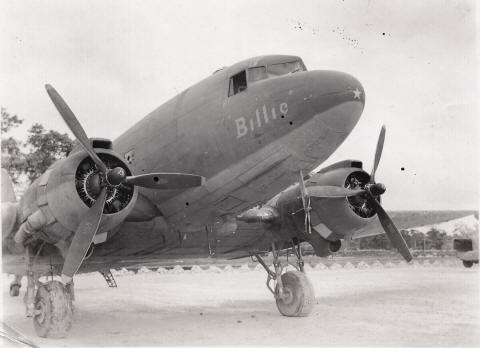
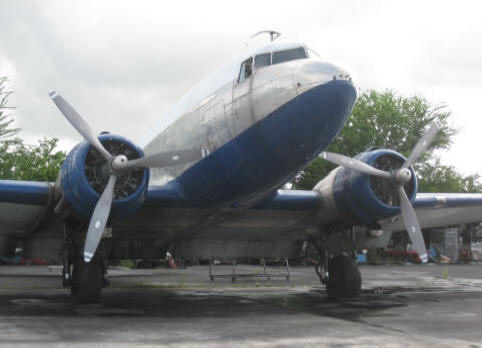
The book and website author Seth Washburne purchased Billie on January 19, 2010, and flew it as copilot from Puerto Rico to Fort Worth, Texas, where he hired a team to restore it. The restoration did not go well, and Bllie's parts are now in a hangar in Lancaster, Texas. To read more about this, please click HERE.
The restoration of Billie was held up while I pursued legal action against James W. Terry, Patrick Mahaffey, Terry Rogers, and related entities, but the lawyers were crooks, too. I plan to write this up at some point. I prefer to not take away from the Thirsty 13th story, but, if interested, click here.
On July 31, 2013, Thirsty 13th LLC purchased building 880 at Lancaster Airport (LNC) in Lancaster, Texas, with three 70 foot x 70 foot bays. Billie is in the middle bay, and the two side bays are leased.
Recent Events: Click here to see photos from the 70th Anniversary Reunion, in Fort Worth, Tex., November 4-5, 2011.
Subsequent to publishing the book "The Thirsty 13th" additional squadron history has been learned. This history, and history-related items, are shared in newsletters emailed to squadron members, relatives, and friends. Click on the links below to enjoy these updates.
2011-09 September update email. - Book, reunion.
2013-11 November Update - Color photos of Northern Solomons airstrips; the Thirteenth Air Force Inactivation ceremony.
2014-05 May Special Update - about the discovery of the engines of a PBY that beached on coral to rescue Captain Cecil Petty.
2014-07 July Update - lots of history and history-related information, including the location of the camp at Noemfoor.
2014-11 November Update - beautiful color photos of the New Caledonia camp in 2014, and the camp location at Clark Field.
2015-04 April Update - the Dumbéa temporary camp location, and Sydney rest leave sites in 2015.
2015-08 August Update - with related Marine squadron items, more great photos.
2015-11 November Update - photos of New Caledonia, Vella Lavella, new squadron plaque, much more.
2016-03 March Update - New Caledonia railroad tunnels, Philippines color photos.
2016-05 May Update - Sydney rest leave location, Biak diary notes, Dulag camps of 63rd and 64th troop carrier squadron.
2016-07 July Update - Wimpy's on Russell Island, Morotai airfield layout, 1945 C-46 crash site.
2016-08 August Update - Drew Field photos, radio operator stories, search for the Lana T.
2016-12 December Update - Wakde bomb shelter, Biak camp, James Claydon background.
2017-02 February Update - API story Manus to Munda; Biak camp, finding men and relatives..
2017-03 March Update - Bob Hope short snorter, Donald Pyke war stories, finding men and relatives.
2017-04 April Update - FEAF combat time boundaries, move to Dulag, Philippines, Japan, finding men and relatives.
2017-05 May Update - Western Scanning Trip, stories, Grand Pacific Hotel Suva, 403rd Group order September 22, 1945.
2017-07 July Update - Typical flights 1943-44, Biak camp areat today, Dulag, 63rd TCS transferred to 13th TCS Nov 1, 1945.
2017-09 September Update - Results of Part 1 of a 3-week scanning trip.
2017-10a October Update 1 - Results of Part 2 of a 3-week scanning trip.
2017-10b October Update 2 - Results of Part 3 of a 3-week scanning trip.
2017-11a November First Update - Pilot and navigator 1942-43 landmarks from New Caledonia to Munda, Auckland, Tonga.
2017-11b November Second Update - Camp Stoneman barracks location, and the ferry to Fort Mason.
2017-12 December Letter - 1942 convoy to the South Pacific, identifying more members.
2018-01 January Letter - Stirling Airfield photo, Biak photos, reaching relatives of 35 more members.
2018-02 February Letter - Photos from Biak, stories from pilot George Laycock, aerial views of airfields at Dansalan (Marawi City), Malabang, Parang.
2018-03 March Letter - Russell Islands, Pekoa, aerials of Mindanao airfields Anakan, Bahi, Farm 7, and Padada, and Sanga Sanga on Tawi Tawi, Palawan.
2018-04 April Letter - C-47 Lady Eve, Marines flying our planes, diary of Lenard Davis.
2018-10 October Letter - Clark Field Zero on pole, New Caledonia jeep, original patch, Bill Alexander letters, items from Cady, Kulikoff.
2019-01 January Letter - Items from Elam, Saltsman, Alexander, blue-bordered patch.
2019-03 March Letter - Items from Powell, Hershberg (including a new patch design), Groesbeck and Aos.
2019-07 July Letter - Drew Field layout from H.C. Myers, Klipfontein coordinates from James Wallace grandson, Taylor Cloud stories, Los Negros Salami Plantation. Scanning trip Part 1.
2019-08 August Letter - Klipfontein Guard Log, Matsonia Guard Log, items from Nogaj, Markowitz, Domarski, and James Davis, National Archives films, Arthur Golomb Arlington Funeral and B-52 Flyover. Scanning Trip Part 2.
2019-09 September Letter - Items from Cummins (Drew Field, Pope, and New Caledonia), MacLeod (Drew Field and Pope), Merriott (Lockbourne, Sydney), Strode (1942-43 letters), Lenard Davis (Biak and 2nd Dulag camp), and Laycock (Townsville). Scanning Trip Part 3.
2019-10 October Letter - Founding members roster, move to New Hebrides, items from Malloy, National Personnel Records Center, memorials to five who passed away. Scanning Trip Part 4.
2020-01 January Letter - Assigned vs. attached, Army of the US, roster additions, morning report details, move from Biak to Leyte, glider echelon explained. Download a draft roster here, and download a draft of movements to other bases here.
2020-05 May Letter - Download a first draft of all the squadron overseas flights in four PDFs here: PDF1, PDF2, PDF3, PDF4. The newsletter reveals what is in the the flight list, e.g. the takeoff times, and destinations.
2020-06 June Letter - Photos from 1942-43 pilot Bergstrom, exceprts from letters from 1943-1945 aerial engineer LaLonde.
2020-07 July Letter - Items from Zechar, Linkenhoger, Burder, Nichols, Stoltzmann, Develin. C-47 load adjuster from Billie.
2020-09 September Letter - LaLonde letter excerpts, stories from Wilson and Baldry
2020-12 December Letter - Franz logbook, First year anniversary party, stories from Stoltzmann and Marchant, photos from Scofield. The legacy of Emerson Paul King. Identifying all the members, and contacting relatives.
2021-01 January Letter - Goessl painting, Items from Moyle and Voorhees, 403rd TCG T/O, compliment from Dana Bell.
2021-02 February Letter - Layout of enlisted and officer areas of camp at Dulag Leyte, 1945.
2021-03 March Letter - Estimated routes of 1942 troop trains which moved the squadron from Pope Field to Lockbourne, and Lockbourne to Camp Stoneman. Items from Lester Ford. Stories from Arthur Driedger.
2021-04 April Letter - Items from Albert Eastburn, 1941 to 1945. A link to the Instructions for Use of the Astro Compass Mk. II by the W.W. Boes Company, Dayton, Ohio, from the collection of 1942 navigator Ralph L. Saltsman, and shared by his niece, Maidi, is: here
2021-06 June Letter - More items from Eastburn, including the Hickam Field takeoff location, Carney Field, and the Biak 41st Division Cemetery.
2022-01 January Letter - Evans notes, Gagliardi photos and stories, Biak camp area today, found last four death dates.
2022-03 March Letter - Items from Mullin, Lach, Cohen, Abramowitz, February 2022 visit to NY and MA.
2022-04 April Letter - 1943 New Caledonia award ceremonies, McDonought Items, Gunderson diary.
2022-05 May Letter - 1944 and 1945 award ceremonies, summary of all awards, including of the Good Conduct Medal.
2022-06 June Letter - Award cards from National Archives, Evans letters, and McDonough flight log and September 10, 1945, roster.
2022-08 August Letter - Camp Stoneman, stories from Dolney and Burder, photos from J.N. Smith.
2022-09 September Letter - American Fly-Boy book excerpts, the 17 souls entrusted to and lost by the 13th TCS in our one fatal accident with passengers, Espiritu Santo in 2022.
2023-01 January Letter - Western Pacific Campaign, Biak and Dulag photos from Gunderson, Amelang Items, Art Driedger stories.
2023-06 June Letter - New Caledonia IITYWYBAD sign, photos from Hall, items and quotes from Amelang, Kearns map, Caldwell crash site, last enlisted man passed away.
2023-11 November Letter - Location of camps at Dumbéa, New Caledonia, and Los Negros, including of the HQ 13th Air Force. Wright photos of move to Los Negros. Update on research activity. Found location of all officer Individual Flight Records.
2024-02 February Letter - Another Army Commendation, photos from Edward Watland, stories and photos from the 64th TCS's Roy F. Powell including the 64th TCS camp sign at Biak, more photos from Max Schneider and Thomas Wright, and stories from glider pilots Marchant and Noakes.
2024-06 June Letter - New Caledonia dock location for the ground crew on MS Klipfontein. Nose art "Johnie." More photos from Bill Bond. Ewan Stevenson photos of Nouméa and "the mountain with the white spot." Kimball Hill crash of Marine R4D October 9, 1942.
2025-04 April Letter - Reef landing additional story. Kia Ora photos. Letters by Morris "Bob" Bakken. Photos from Homer Grady Bowen. Removed 11 men who were assigned but never joined. Found 1941-42 start dates for 156 men. Reviewed 160 members to find contacts and reached relatives of 35 men.
2026-02 February Letter - C-47 Nose Art Name Comance Belle origin, 8th General Hospital and 29th General Hospital locations, Winston N. Howell practiced for the Shangr-la rescue, Photos of Milton Bromberg, recent activvities.
Three PDFs of additional research are available here. The typestyle may appear clearer if you download the PDFs to your computer, and then open them as PDFs, rather than reading them in your Internet browser.
Oshkosh 2015 Presntation "Research a Military Unit" - about book writing techniques.
Download a PDF about a B-17 (with my uncle as co-pilot) shot down over Germany July 31, 1943, here.
Download a PDF about a U.S. Navy C-117D (# 017152, with my brother as a passenger) that ditched off of Guam August 14, 1978 by clicking here.
Download the Thirteenth Air Depot Group Headquarters Squadron book in two parts, including an intro and index of names and photos by me, in two parts here and here.
Download the 64th Troop Carrier Squadron yearbook here.
Download the 8th General Hospital New Caledonia location here.
If you are related to anyone who served in the 8th or 29th General Hospitals, please know that the son, Greg, of a 29th GH surgeon is gathering photos and stories for a book or PDF. Please read the additional information. here.
As always, any feedback or comments on these PDFs will be greatly appreciated.
This website, book, airplane restoration, videos, and events were the idea of Seth Washburne, son of Thirsty 13th 1942-43 navigator John Washburne.
I am always eager to learn more about the squadron, and so if you have any information you would be willing to share, it will be greatly welcomed. I also welcome correspondence from others who have an interest in the Thirsty 13th.
I may be reached at sethpw1@gmail.com. You may also call me at (212) 289-1506 (mobile). This page was last updated on January 19. 2022. Thank you for your interest in The Thirsty 13th!
All content copyright: Thirsty 13th LLC.
